Showing posts with label Gender. Show all posts

Tuesday, February 28, 2017

Anaconda


Many of todays music video are quite the same, women dancing and showing off their figure in the videos. The music video “Anaconda” by Nicki Minaj came out in 2014. In this music video it shows many women in revealing clothing and shaking their hinds quarters. Matter of fact, the open scene of the video starts with two women shaking it. The music video uses the women to appeal to the man's eye in a sexual way, also known as these women are being shown as sex objects. The music video is half visual and half hearing which means that the lyrics of the song are also giving a message to the viewer that they have to be a certain way in order to fit in.

The music video is for everyone to see but everyone knows that the main target for the music video is for men. From the opening couple seconds of the song to the ending moments of the songs it's all directed to appeal to the man's eyes. The director made sure to get women with a pretty face but also good body parts. The women in the video are dressed very similar with their butts hanging out of their shorts and their breasts popping out. These women are all being viewed as sex objects. The women in this video are telling the girls that are watching this to dress and act like this in order to fill needs of a man. On top of that, the actual women in the video dress like so are also being used for men's sexual pleasure. The target audience is the men and the gaze that the men show to women. Everyone in the world can almost say that because of what the women are doing. This is showing that the only way to entertain a man to by having women dress up like that and dance like that. What type of message does this send to the younger girls watching this? This video can connect to the real world because often times in the media women are always being shown as sexy and slim but thick in the right places. This almost impossible figure to get is telling these ladies that to please a man you have to look like that and have that type of body and are willing to show it off.

The music video is half visual and half hearing. If you listen to the lyrics it sends a direct message to women. In the song it says, “ My anaconda don’t want none unless you got buns hun.” This is also sending a direct message straight to the women because its saying that without a body no man will want you. Women have to fill that position of having a nice body or else a man will not want them. Also in the song it reads that, ”F*** them skinny b*****s in the club I wanna see all the big fat a** b*****s in the motherf****** club F*** you if you skinny b*****s. What? Yeah. Ha-ha, ha..” This here is literally calling out skinny women in the world. It's literally saying that if you are skinny, that has to change because the only way you will be accepted is that if you have a thick body in the right places. This connects to today's situation because for so many years women have been trapped in this box where they have to fit this perfect image or they won't be accepted.

To conclude this music video portraits the women as sex objects to the men and the lyrics speak to women that you need to fit into this or you are out. This video is like a two in one effect for visual and hearing.

Monday, February 27, 2017

The End Justifies The Means

Many chick flicks and romance movies that were produced from the early 2000’s to around the turn of decade portrayed women to be stereotypical. One of the more classic chick flicks, Mean Girls, was released in 2004. Many people view it as a comedic, funny movie; while this may be true, I think the movie has caused a lot of controversy due to the way women are portrayed in the movie. Mean Girls, directed by Mark Waters, is about a teenage girl named Cady Heron who was home-schooled in Africa by her zoologist parents before moving back to the United States. When her family moves to Evanston, Illinois, she is thrown into the seemingly overwhelming transition of being homeschooled to hectic public school atmosphere. Cady starts to notice the cruel hierarchical ways of popularity that divide her fellow students into tightly knit cliques. She unwittingly finds herself in the good graces of an elite group of cool students called the plastics. This Movie reflects ideologies of a patriarchal society because it shows that women should conform to men’s wants and also supports the idea of having the ‘perfect’ body standards to please men, which is all very evident throughout the entirety of this movie. This movie is one of the most popular movies of the 21st century and the effects of that contributes to the formation of stereotypes, like the ideal body shape and relationships with women and men.

The movie Mean girls supports the stereotype that women should do anything for the man they like, including change themselves. This is very obvious throughout the movie as Cady and Regina George, the leader of her adopted friend group “the plastics”, go toe to toe for most of the movie over, Aaron Samuels, Regina’s ex-boyfriend. When Cady first meets Aaron she immediately develops a crush on him, Cady tells the plastics (Gretchen & Karen) about her crush on Aaron and they both inform her of how Aaron is Regina’s ex-boyfriend and is declared 100% off limits for anyone but Regina. Even though she was told he’s off limits she still tries to do whatever she can to get Aaron, even turning on Regina. A prime example of her doing whatever necessary is telling Regina about these Polish Nutrition bars that make you “skinnier” and giving them to her. While in reality, these Nutrition bars are specifically made for people who want to gain weight the only thing that stops Regina from reading the label, is the fact that it is in polish. So Regina takes Cady’s word and eats them, thinking she would lose weight, but in reality she slowly gains a few pounds. Cady’s goal by giving her these bars was to get Aaron to stop thinking Regina is attractive which would make Regina lose her popularity thus giving Cady no competition. Cady also throws a party going against her parents words and breaking their trust for the goal of hooking up with Aaron, which was unsuccessful, and ends up pushing him away. Her attempts to win over a man and please him, not only led her to turn against one of her friends, but also defying her parents in an unsuccessful attempt to get closer with Aaron. These examples in the movie spread the subliminal message that going to extremes and risking other things in life is ok if it is to please a man, which is the wrong message to be spreading and has consequences in society.

My argument applies to my piece of culture because it shows how the movie enforced the stereotype of how the man should come first. It teaches women that changing who they are to get a man is acceptable even if theirs or others images are tarnished in the process. I have seen in my life people who have changed how they act to please someone they liked a lot.

Thursday, February 23, 2017

Different Understanding of Television

      Social norms have been constructed in social media and TV for a long long time. Men and women play a significant part in social norms and how society wants them to be and appear to others. Though men and women play very different roles, both genders have been assigned ideal characteristics that make them a man or a women. This is called a stereotype. These stereotypes are assigned to a person’s nationality, sex, gender and even sexuality. People can be based off these “stereotypes” because it has been portrayed everywhere. The television show Two and a Half Men focuses on the objectification of women and the men’s behavior towards them in order to show that women are sex objects and do not seem to respected unless they are older and less attractive. Only when humans acknowledge and become mindful with the truth, then society can begin to solve the problem of stereotypes being held towards anyone.
       In “‘Camel Filters and Pheromones” (season 1, episode 12), the most important stereotypes being portrayed are the player, the seductress, the old maid and the sex object.  For example, Berta’s granddaughter asked Charlie if he could play the piano which was pretty obvious he could as she was staring at him play but she gets closer enough to the point where she starts asking for one on one lessons but he said no but she still tries to come onto him. She desired to get their attention. Prudence would be stereotyped as the seductress but also the sex object. She enters the show in almost half dressed and she has to clean and while she is cleaning she is wiping the window in the most provocative manner right in front of Alan and Charlie. Her appearance conveys a powerful erotic impact, the camera focuses on her body, mainly when she has a bikini or her other provocative clothing rather than us seeing her face of something. This is a construction of women being objects in men's eyes.  She is being watched and drooled over by Alan’s 10 year old son.  Plus, she was not the brightest person. She is not viewed for her intelligence or her cleverness or any other characteristic, only her body is what matters. Nothing else. Another example is Berta herself. Berta was a single mother but she was a housekeeper for the men of the house. She is a very outspoken, over 30 woman. She was barely put into the show, she had a little part and when they show her, the camera is not focused on her body but what she is saying and even her face. She is very well respected by the men. While the character Charlie is a very sexual, uncommitted man. For example, the reaction from Charlie of when Berta entered the room and. when Prudence entered the room. Charlie was very shocked and he had to maintain his boundaries because she was underage but if she was older, he would have taken the chance. Another example is his neighbor, Rose. She is  very much in love with him and she hopes that they will sleep together again but he all he does is reject her. Charlie uses Rose to make Prudence stop coming on to him, only using her to his advantage and benefit. He slept with her once and after that, he just messes with her emotions and uses her whenever he needs her. He does not care for these women, he just uses them.

In conclusion, this work is just one of the many examples of where you can find stereotypes within media. It can be portrayed in life as well. In my life, my dad always feels as if a man should always care for the woman. He believes that because I am a female, I do not lift heavy objects and I am to cook and clean the house when necessary. While my brother cannot help with his sister’s hair because it affects his sexuality and it is making him not masculine. He is not allowed to let females do heavy labor because it is not meant for a female. Stereotypes are within our nation and more around you then you realize. It is fair for my brother to be put on with so many expectations and pressure just at the age of 13. Honestly, being a son to a father might just be harder to be a daughter to a father. There is more of a expectation to be just like “his old man” and if he does not, there might not be an acceptance. That is what social norms, pressure from society and stereotypes have constructed for people to believe.  It is only when we pay attention it and do not further allow it is when we have end it for good.

How Modern Music Brings Back The 1920's

The song “Be Together” by Major Lazer is old school. It expresses many different stereotypes, but there are a few prominent ones for men and women.  This work also expresses a few ideologies, one of those being “women in the roaring 20’s.” The gender stereotype expressed for men in the song are the gangster. For women the seductress / mistress stereotype is shown.

The group that made this song is called Major Lazer. They are a group of guys who use many different people to perform in their songs. They recently made album with many different singers, men and women. One of the songs in the album “Be Together” is performed by Natalie Bergman, and the song is from her point of view.

There are many examples of the “women in the roaring twenties” in this work. The first line of the song is a great example of the ideology of the twenties Natalie Bergman says: “Let me escape in your arms, baby I'm yours, baby I'm yours.” This supports the ideology of the twenties because in that decade women were expanding their ideas about how they were allowed to act and talk. They wanted it to be socially acceptable to be attracted to men. Women wanted to break the stereotype that they were supposed to be pure and chaste sexually. Another example of how this song expresses the ideologies of the 20’s is: “Maybe on the dark side we can be together, be together.” This expresses 20’s ideology because women in the 20’s wanted to show their, “dark side,” more. Women wanted to be more disobedient and more out of the home, and this line connects to the 20’s idea that women wanted to disobey their parents in order to be with men.

Beyond 20’s ideologies, “Be Together” expresses a lot of stereotypes of men and women. The first stereotype of women the song expresses is the seductress stereotype. A great example of this in the song is: “Maybe on the dark side we can be together, be together.” This quote shows that she is trying to seduce the man to the, “dark side”. This is part of the seductress stereotype. One of the stereotypes of men in the song is the gangster. This stereotype is expressed by this quote: “Tell me, is this freedom, baby? Chasing after danger, making my heart race.” This expresses the gangster stereotype because the guy is trying to impress the girl and win her over. This is also expressed by this quote because he is being a bad boy. Another quote that shows the same thing is this quote: “He was a dreamer at heart chasing the stars, chasing the stars wings spread to the sun I miss you so much, I miss you so much.”

The idea of women expressing themselves and still being accepted for it hasn’t been around for very long time. But popular culture and modern media are accepting it by leaps and bounds. This song isn’t the only piece of culture that expresses these ideologies and stereotypes.


The Simpsons


Episode 590 of The Simpsons reinforces dominant ideologies about gender roles with exaggerated portrayal of society’s gender stereotypes shown through a comedic lense. This is apparent in the actions of the female characters, in private conversations about women between male characters and in interactions between male and female characters.

The Simpsons promotes dominant ideologies about gender and gender roles through the actions of female characters. When Homer finds he is too fat to sleep comfortably in his space pod, Marge adjusts it to fit obese people. Marge figures out how to be a scientist by relating the experiment procedures to household chores. She says,

“Mom’s spend their whole lives obsessing over unlikely catastrophes. In space, that’s what you’re supposed to do”. This rhetoric propagates the stereotype of the women as the nurturer. It depicts women working in STEM fields as a laughable concept and irrational as their proper place is in the private sphere.

The Simpsons promotes dominant ideologies about gender and gender roles in private conversations about women between male characters. The men are stupid and clumsy, but ultimately, they are in control. Homer and Bart “support” the women in their lives through the same robotic support scheme despite the differences in their relationships (wife and sister). As they are alone throwing a ball in the backyard together, Bart says to Homer, “That listening to women junk you taught me really works!”, Homer responds by saying, “The trick is in the nodding”. Bart then delivers a more explicit commentary on gender roles and gender stereotypes. He says to his father, “Dad, after seeing mom and Lisa go at it, I’m glad our relationship is about physical abuse, not psychological”. While this line does outline one of society’s gender stereotypes, it presents the stereotype through a sarcastic and comedic lense framing it as something that it laughable and insignificant.

The Simpsons promotes dominant ideologies about gender and gender roles through interactions between male and female characters. During the scene on the Martian colony, the men in charge compliment Marge because she can do chores more efficiently that the robotic arm. This is an example of comedy being used to promote gender roles and gender stereotypes. It perpetuates the notion of the woman’s proper place being the private sphere. Portraying a woman as being able to do household chores more reliably and more effectively than a robot not only reinforces the dominant ideology of the woman belonging in the private sphere, it also objectifies women. Later, during the rocket launch, Homer and Bart freak out over the idea Marge and Lisa going to Mars because they don’t know how to survive on Earth without a woman to go grocery shopping, cook and wash dishes for them. This joke, while at the surface appears to present the importance of women in the lives of men and how stupid and useless men can be, the fact that the men are worried about tasks as simple as dish washing and grocery shopping demeans women and asserts that they are inferior to men.


These are examples of dominant ideologies about gender being reinforces through comedy. While The Simpsons appears at the surface to be an innocent comedic cartoon, underlying the comedy is a more sinister system of reinforcement of society’s dominant ideologies of gender and gender roles.

Wednesday, September 28, 2016

Role Models vs. Mirrors


Hillary Clinton's new campaign advertisement, Mirrors should have succeeded where Role Models failed to show the detrimental effects that Donald Trump could have on the future and the youth of America because of his poor character and the dangers of having a leader who does not lead by setting a positive example. The Mirrors advertisement ultimately failed because it did not show that Clinton is the positive role model that America needs.

The new advertisement, Mirrors might as well be a revised edition of the Role Models advertisement that she released in July. Role Models did not succeed because it portrayed Hillary Clinton as a positive role model in contrast to Donald Trump. This was not received well because in July, when the Role Models ad was released, only 28%-50% of the population had a favorable view of Hillary Clinton. Mirrors makes the same arguments as Role Models did, and follows the same format except that it shows only young girls, they are looking at themselves rather than Trump and Clinton does not appear in the ad. The most significant difference between the two advertisements is that Hillary Clinton is not included in the Mirrors ad. The most prominent complaint about the Role Models video was that it attempted to portray Clinton as a positive alternative to Trump in the last few seconds of the ad. This part of the video is somewhat hypocritical in that it is saying Clinton is a positive role model and a strong character-ed alternative to Trump at the end of an attack ad. The Clinton campaign's solution to this problem was to make a new ad in the same format but without mentioning Clinton at all. This decision only led to another failed advertisement. The Mirrors ad has no positive alternative to Trump's rhetoric which will draw unfavorable response not only from Republicans and independents but from Democrats and Clinton supporters as well.

The failures of these two advertisements to convince voters to support Hillary Clinton is evidenced by the viewer's responses on YouTube. The Role Models video has 1,283,781 views 11,424 likes and 13,322 dislikes. This puts percentage of viewers who liked the video at 0.890%, almost five times lower than that of the average YouTube video. The video's 46 to 54 likes to dislikes ratio means that it is in the most unpopular 4% of YouTube videos and is about 11 times more unpopular than the average YouTube video. Contrary to the intentions of the Clinton campaign, Mirrors performed even worse. The Mirrors video has 4,717,092 views, 27,042 likes and 45,156 dislikes. While Mirrors has bring in about four times the viewership of Role Models and therefore more likes and dislikes, its percentage of viewers who liked the video is 0.573%, about 1.5 times lower than Role Models and almost seven times lower than the average YouTube video. The video's 37 to 63 likes to dislikes ratio means that this video is also in the most unpopular 4% of YouTube videos and is about 15 times more unpopular than the average YouTube video. Therefore, Mirrors has had an audience response about 1.5 times more unfavorable than that of Role Models. This contributed to making Mirrors an even less effective advertisement than Role Models. Role Models gained 575 new subscribers for the Hillary Clinton YouTube Channel while Mirrors gained only 394 new subscribers. About 0.048% of unsubscribed viewers subscribed to the Hillary Clinton YouTube because of the Role Models video while only 0.0085% of unsubscribed viewers subscribed to the Hillary Clinton YouTube because of the Mirrors video. This means that Mirrors was about 5.6 times less effective at bringing in support to the Clinton campaign than Role Models.

Monday, September 26, 2016

Just How Sexist Is Donald Trump?


Hillary Clinton nailed this ad. This ad is made for not only the daughters out there, but the mothers, the fathers, and even the sons, because we can be self-conscious sometimes too. Hillary Clinton shows in a short amount of time just how sexist of a person Donald Trump is. Do we really want our president to be sexualizing his employees and our daughters?

This ad appeals to people of all nationalities. It does not appeal to just rich white people, as Donald Trump does, and it also appeals to people of all ages, which Donald Trump does not do either. This ad will help persuade people on the fence, because it shows how Donald Trump does not have a filter, and it shows what Donald Trump is really like.

Sunday, September 4, 2016

Can You Handle That?

The song “Like A Boy” by Ciara from her album The Evolution is a true story because it connects with real life situations and emotions that others can relate to,but this song seems to promote the stereotype of men being jerks and always doing women wrong but also the double standard that men are justified for their behavior but if women were to do the same thing and behave the same way then women would be looked at differently as well as judged.. For example, Ciara says, “If I played you… Would you like that? Had friends… Would you like that? Never call? Would you like that?”. She basically says that men would not like the treatment women receive. Men get praised for having slept with multiple women but when women do the same things that men do they receive names and this new image of themselves (a whole new representation of themselves and how people see you).

Another example, Ciara says, “Would the rules change up? Or would you still apply? If I played you like a toy”. If the roles were reversed women are petty or they are stooping low and the men all of a sudden feel hurt but even though these situations do occur but it does not happen with every male women face. An additional example, when Ciara talks about how they cannot handle if the treatment they give to women were returned. This situation promotes and somewhat generalizes how all men are jerks and they mistreat women. Not all men are like that and it makes it hard for the good guys out there to get a chance with these women when they have been user to these “players”.

Friday, September 2, 2016

Profound ideologies in ¨The Revenant¨


The Revenant, is the story of a father and son who set out on a dangerous expedition with a group of men to explore America in 1823. This story is a false story because it supports unrealistic, but desired ideologies. The storyline portrays men as being unstoppable, if provoked, and truly filled with an unrealistic rage. Most men could not survive ridiculous bear wounds, as well as many other gruesome injuries, but not Leonardo Di´Caprio(the main character/father). The idea that men must do the dangerous exploration as well as other vigorous tasks is also shown throughout, as women play a miniscule role in the film. This relates to the American ideology that men must do the hard labor and be strong. Finally the ¨Justice will always prevail¨ concept is clear throughout, as the father goes through enormous tasks and injuries, yet still gets revenge in the end. This also connects to Tim O´Brien´s words, as no true story will leave you uplifted in the end, and will never be moral. Overall The Revenant was not a true story.


Nice Guy's promotes racial/gender equality?

Image result for the nice guys
The film The Nice Guys is a true story because of how it is designed to defy expectations through its portrayal of death, its positive message about environmentalism, and its characterisation designed to subvert stereotypes. Death is portrayed sudden violent, and almost in a comedic light. This reinforces a recurring theme of how people die for stupid mistakes and coincidences, the best examples of this is that when the character Amelia escapes an assassin meant to kill her then proceeds to walk up to a car to ask for a ride out of there only for it to be the assasin’s car. Another example is when the two main characters talk about Richard Nixon coming across someone who was dying in a car crash and telling him he’ll be okay only for him die immediately after that. In both instances the deaths are unexpected and abrupt as opposed to the usual deaths in films that are foreshadowed and give the characters memorable last words.
Another truth the film portrays is a positive message about the environment which is done subversively by not having the movie revolve around environmentalism, but instead having the story gradually move towards it becoming the focus. At the start the environmentalists are shown to be dumb hippies playing dead in the middle of a park to protest, they were mostly used as comic relief. However as the film progresses the main characters slowly realize that the hippies were right and their isn’t ridiculous having the third act revolve around them protecting a porno film containing an environment message exposing the big car companies.
The final truth that the film how it betrays the usual stereotypes of people. Almost every character that isn’t one of the two main characters subverts some stereotype. Holland March and Jackson Healy (the main characters) would be nowhere without Holland’s daughter. She helps get them to find clues and is shown to be competent and useful in the many dangerous situations she is put in despite everyone around her assuming that her character is a naive and helpless child . Another example of this subversion of stereotypes is the character Tally, a black woman who is one of the two biggest obstacles for Holland and Jackson, and is able to trick both of them twice, and whose race isn’t brought up despite the film taking place in the 70s. The final example of this subversion is the old lady who got Holland and Jackson into the case in the first place. At the beginning she is shown to be senile and delusional, but by the end she is able to help the two find the final clue that would help them solve the case.                    


The Perfect "American Dad"


American Dad is a show aired late night, a cartoon for teenagers and adults. The show perpetuates the ideology of how a man is supposed to be, and what he is supposed to do. Stan, the main character and father, works for the CIA and is shown as incredibly muscular and big. He has a deep voice, proudly wears the American Flag, and is the sole provider for his family.


His son, Steve, is a sympathetic “cry-baby”, but Stan, being the perfect “American Dad”, has to make his son into a man by hammering the ideology of the perfect “American Man” into his head. The perfect man in America is usually big, muscular, handsome, rich, and brave, and all of these qualities describe Stan.

Friday, March 11, 2016

Women in Country Music


The country song, “A Girl in a Country Song” by Maddie and Tae, criticizes how women are portrayed in country songs. This song is breaking the stereotypes of women by talking about how they feel about the ways they are portrayed and the thoughts going through their minds about these different stereotypes. Women have fought to be seen as more than just an object in the eyes of men. Many country songs have set back all that women have fought for.

Women in country songs are too often objectified, sexualized, and seen wearing little to no clothing in many of the lyrics and music videos. A Girl in a Country Song states how women feel about the things they are made to wear in the music videos: “Well, I wish I had some shoes on my two bare feet. And it’s gettin kinda cold in these painted on, cut-off jeans. I hate the way this bikini top chafes, Do I really have to wear it all day? (Yeah, baby)” Women are being made to feel uncomfortable in order to make themselves more appealing in the eyes of men.

Another verse in the song goes “I hear you over there on your tailgate whistlin’. Saying ‘Hey Girl.’ (hey, girl). But you know I ain’t listenin. Cause I got a name, And to you it ain’t ‘pretty little thing’, ‘honey’, or ‘baby’.” This verse is a really good representation of how men “catcall” women and how men think they can say anything to a women, without respect. This is seen in many various country songs, where many male singers only write lyrics about a woman’s appearance. Songs that are like this fall under the category of “guy country” which would give it the excuse to be degrading and disrespectful to women. Another verse in the is,

Like all we’re good for,
Is looking good for you and your friends on the weekend.
Nothing more.
(Woo) We used to get a little respect.
Now we’re lucky if we even get.
To climb up in your truck, keep our mouth shut, and ride along.
Down some old dirt road we don’t even wanna be on,
And be the girl in the country song.


This verse is very powerful because it shows how women will sacrifice everything they stand for to make men happy, because women were always told it was part of their “duty” to keep their loved ones happy. Women and girls have also been told, for generations, to be seen and not heard. Based on this verse, women are still treated with the very traditional and “old-time” ways of how women should be treated. Country music originates in the Southern United States which has always been known to be very traditional, which makes sense as to why men are very dominate over women in many songs that are considered country, but it doesn’t say or do much for what women have accomplished.

Most country songs set women back generations when they have fought for so long to be where they are now. Women are still underestimated in their capabilities, along with their ability to do the same, or even better, than a man. Many country songs have set women back from many accomplishments they have achieved. Women have fought to be seen as more than just an object in the eyes of men, while many country songs subtly show discrimination against women in the words they chose for their verses, and many have stereotypes that haven’t been used for decades.

Thursday, March 10, 2016

There's More To Empire Than What Meets The Eye


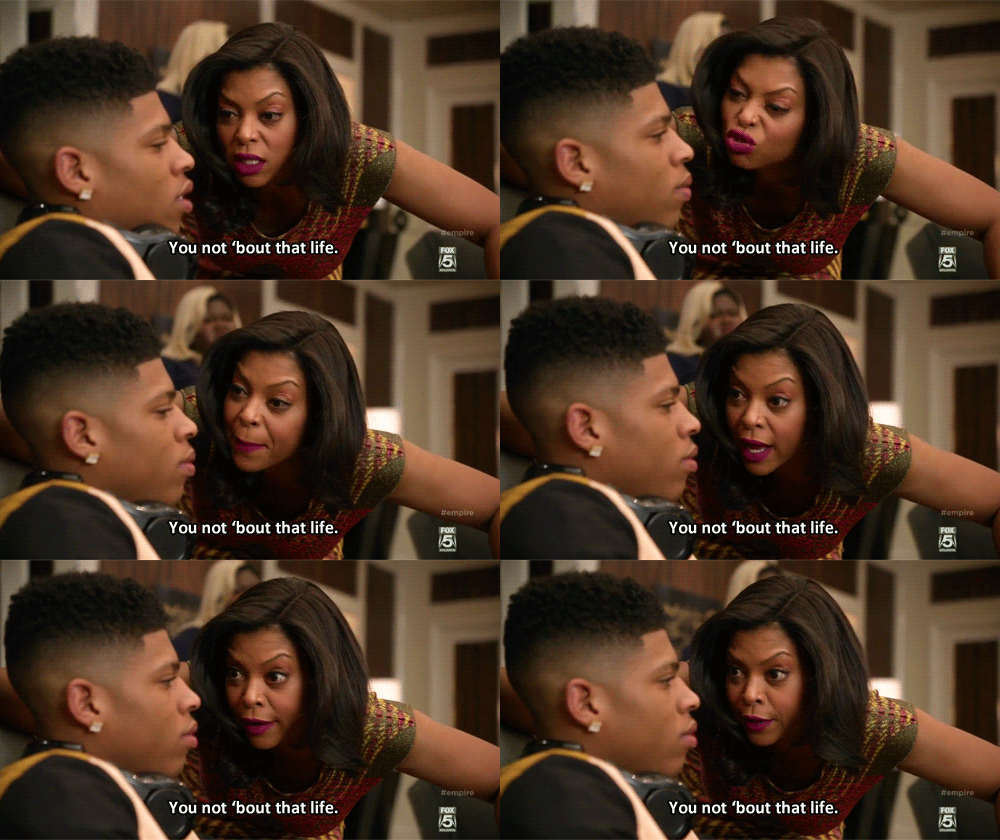
Empire, a hit drama on Fox that is centered around the hip hop industry and drama between the family members who built it, exposes a wide variety of stereotypes. The show does not only defy gender stereotypes but it also addresses racial stereotypes as well. Empire is a work of feminism because it is resisting typical roles that women play in the public and private sphere, while also redefining what it means to be a woman in America. In popular culture women are often portrayed as either a wife/mother that is submissive to a man or a sex symbol/seductress that has evil power over men. It is very refreshing to see a complex character such as Cookie Lyon (Taraji P. Henson) that takes aspects from both sides of the spectrum and breaks both stereotypes. While the show is very complex it does a great job at using satire to expose the inequality that is so heavily embedded in American culture.


Cookie Lyon automatically breaks the pure and dainty stereotype for women because in the first episode she is being released from prison. The show becomes complicated when it is revealed that Cookie took the fall for Lucious Lyon (Terrence Howard) by not giving him up when she was caught by the cops. This raises the question is she really showing agency since the reason she is breaking one stereotype is for the “service” of a man, another big stereotype of women. It is clear however that regardless of the reason she still isn’t what was once the ideal woman simply because she was not there for her children and family for 17 years, due to incarceration. Cookie also changes the role of a mother by protecting and providing for kids, a role that was originally a “man’s job.”Cookie goes to extreme lengths to help her sons, such as going up against their “evil” dad Lucious and starting her own label called Lyon Dynasty. This shows independence and that Cookie is fully capable of being their for her son and living her dreams. Cookie also breaks the stereotype that all wifes/mothers can’t be sexy. Cookie is both the seductress and the mother, however she uses her “evil powers” over men for the benefit for her son’s. At one point Cookie rekindles a relationship with an old friend to get a song for her son Jamal.


The agency shown by Cookie in Empire is amazing, even though to break a few stereotype others were enforced. I think overcoming this unequal ideology is a give and take relationship in which you have to lose some battles to win the war. Just as in real life women are starting to be made up in their image and not in the eyes of a man. For this to continue works of feminism such as Empire must to continue to be created to show the world that while equality may not be simple it is definitely achievable, we all just have to do our part.

Blondes Prefer the Rich

The 1950s was an era of change, and new ideas were being introduced. Gender roles, for example, were changing. Marilyn Monroe supports the ideal body image of the era within her movies. In the 1950s, Marilyn Monroe was best known for the “dumb blonde character,” fulfilling the sex object stereotype. As time moved on, Marilyn Monroe became more of a seductress stereotype, seen by society as a sex icon and was part of the change in the era’s attitude towards sexuality in the 1950s.

One of Marilyn Monroe’s best movies was “Gentlemen Prefer Blondes.” The movie is based upon on a character “Lorelei Lee” (Marilyn Monroe), a beautiful showgirl who is engaged to a wealthy character named “Gus Esmond” (Tommy Noonan) who believes that Marilyn is only after his money and discovers later, she really was. As Gus gets deeper into the mystery to disqualify “Lorelei Lee” from marriage, and stopping her from receiving his money. 


As the movie continues Gus sends Ernie Malone, who is a private detective, to investigate what's going on. Lorelei says, “Don’t you know that a man being rich is like a girl being pretty? You wouldn’t marry a girl just because she's pretty, my goodness, doesn’t it help?” The character displays that she can be a seductress, Esmond Sr asks, “Then what do you want to marry him for?” Lorelei Lee says, “I want to marry him for YOUR money.” This is one of the many moments in the movie where the stereotypes still continue.

In the 1950s women were thought to be stupid since women didn’t go to school or didn’t finish college. “Gus” thought “Lorelei Lee” is stupid, and he was expecting her to sound stupid too. “Mr. Esmond Sr” (Gus) says, “Say, they told me you were stupid! You don’t sound stupid to me!” Lorelei Lee says, “I can be smart when it's important.” This reinforces a stereotype of women being dumb and mistreated. The only time when men wanted to listen to women, were only if they were sexy.

Our final stereotype is the character “Gus” in the movie. He is a wealthy man with lots of money and power. In the movie he is seen as an opportunity for Lorelei to get anything she wants. Also Lorelei Lee can keep all the money to herself after a divorce. This example is important because Lorelei is breaking the stereotype of a woman being dumb and only there to serve her husband. She thinks of a method to receive all the money to herself so that she can enjoy life without any worries at all. Lorelei Lee says, “I want to marry him for YOUR money.” 

Our pop culture slightly changes over the years, but can still support the stereotypes that are being presented today. Women today are still being mistreated more or less. Movies, music videos, television, radio, social media or any entertainment supports the stereotypes. The movie The Wolf of Wall Street, who is a wealthy man, constantly throwing parties. As well as having sexual relationships with women throughout the movie. The movie supports the universal idea that has been continuing since the 1950s. As opposing to women they’re only there for his sexual purposes and needs. In conclusion these stereotypes keep continuing no matter what year it is, and wondering if these kind of stereotypes will continue in the future.

Monday, March 7, 2016

Blurred Lines- Clear Lyrics

The song “Blurred Lines” by Robin Thicke has been talked about as one of the most degrading songs of the year. The song describes how the male is in complete control of the woman no matter what she wants. Women become just sex objects. The woman is also shown as submissive because of the way Thicke convinces her she wants it. Finally, in the video, multiple men are shown as players while women parade around as they watch. “Blurred Lines” by Robin Thicke is a clear representation of contemporary art that represents the still sexist dominant ideology towards women in America today. 

In patriarchal societies, men are known as the superior gender. In the 1950s especially, women were being treated as nothing but housekeepers and sex objects. Today, it is 2016 and for the most part life is very different in terms of equality. Women are getting jobs that they were never able to have, they are able to vote, and they can live a life of their own. Although there are many good outcomes of many feminist movements, there is still discrimination portrayed through social media and society as a whole.

Music has always been something that brings people together, creates strong relationships, and can lift everyone’s mood. The song “Blurred Lines” did just that. It spread throughout the nation and became a catchy tune everyone could get up and dance to. Pop music is known for sounding fun and exciting, making it easy for listeners to get hooked, but then things can turn the other way once you really understand the lyrics. Thicke sings, “Baby, it’s in your nature,/just let me liberate you”.

The context of these lyrics is him mostly likely at a bar or party where a girl is being harassed by another man. He tells her he wants to save her from him and prove he is the better guy. He most likely does this so she will think of him as a tough guy. From this, you may think he is meaning no harm, but then he continues to sing “I know you want it, I know you want it, you’re a good girl.” clearly hinting at sexual acts. This makes him out to be the dominant and her as a submissive because he is telling her what to do and is telling her how he thinks she feels.

As if the song was not enough, there is a video, which magnifies the lyrics and shows them visually. The video consists of multiple men singing and standing there in nice tuxedos while women parade around half naked as objects they can look at. This video clearly objectifies the women as only something nice to look at. The director clearly prefered the male gaze because of the way the men look at the camera. When the women walk by, the men stare and smile and joke to each other as if it was entertainment.

This song and video reflects the patriarchal structure of society by showing men superior from women. This is shown by having the men sing and be the main focus of the song and video, while the women are shown as something hot to look at. The lyrics sung by Robin Thicke are made clear to see the discrimination happening and chauvinism being shown by making it clear the woman does not have a choice in what they do together. 

Wednesday, March 2, 2016

Park and Recreation: Breaking Workplace Stereotypes

For sometime now, Parks and Recreation has been my favorite show. Leslie Knope, who is a main character played by Amy Poehler shows the true power a woman can have in the public sphere, such as the workplace. I went back to the first season to watch an episode that came off as feminist to me, which was episode 4, titled “Boy’s Club.” Throughout this episode many stereotypes of women in the workplace and home are broken. Women in the office are able to join in on the typical men activities in the workplace and the idea of a housewife does not exist. Although this episode and the show in general is pretty feminist, some of the men at the office say some sexist things. The sexist things they say feed into mocking the idea of stereotypes. 

As stated in the title, this episode was about a boy’s club that goes on at the office. The name is misleading though because women in the Parks and Recreation department are treated like one of the guys, equal. Every Tuesday night, the boys club, which is a group of coworkers, meets on the patio outside of the office. One night, Leslie decides to join them with one of her friends, Anne. They are welcomed by all the men and are even allowed to drink with them. By joining the men, Leslie and Anne broke the stereotype that just men drink after a long day of work. They also broke the rules of the boys club, where previously, no girls were allowed. After attending a few meetings, Leslie drops all the bottles of beer on the floor by tipping over the table and the men are cleaning up after her and she says “look at those B---s cleaning up after me.” This breaks the stereotypes that women are the ones who usually do the cleaning. Leslie is also speaking from the stereotypical male’s point of view by stating that the women should be doing the cleaning. 

While the boys cleaned up the beer Leslie spilled off the table, it became clear that the idea of a housewife does not exist. Typically in the past, women are expected to clean and stay at home to take care of the family. That stereotype was broken by Andy, Anne’s boyfriend. When she goes off to work, he cleans the house. This breaks the stereotype the women do the housekeeping. Another typical housewife stereotype is broken by Andy because he is trying to be successful in music but in the meantime, he stays at home and does nothing and doesn't have a job. Anne does. She is the one with the job in the relationship which breaks the housewife stereotype where the women usually stays home and prepare for the family while her husband is at work. Although those barriers are being broken, there is always going to be someone who tries to build those barriers back up.

One of the barriers is rebuilt in this episode because the men say and do sexist things. Ron says his idea of a government is only a man sitting in a room at a desk and have women brought to him when he desires him. This statement is sexist because he doesn’t think that just anyone could run the government, it would have to be a man. He also objectifies women by saying that they should be brought to the ruler of the government whenever. Another example is before Leslie and Anne came along, the men at the office had a boys club where no women are allowed to be in. They meet on Tuesday nights and drink beer. This is sexist against women in a way where they can’t enjoy a drink or 2 with their coworkers because only men are allowed. One last sexist scene in the episode is when Tom asks Leslie if she has every had a dream about their boss, Ron, sexually and she says no. This is the stereotype that workers are sexually attracted to their boss or vice versa. Despite all of the sexist comments that may go on, Leslie never seems to let it get to her and continues to hold her strong beliefs in women in the political world and her home town. The only sexist people in the workplace are the men, which is very relatable to my past work experiences. 

In many ways, Leslie and the other Parks and Recreation characters break the workplace and home stereotypes but of course there is always going to be those people who are sexist and try to break it down again. This occurred in my workplace as well over the summer. My boss would often make the girls clean the locker rooms, at the pool where I was a lifeguard, and always let the boys go home early if the chance came along where we didn’t need any more life guards than we already had. He also gave one of the guys a raise and a higher position but never gave the option to a girl. By the end of the summer all the girl lifeguards could tell that he was always in favor of the boys and was just all around sexist. My boss relates to Ron, the parks and recreation department head. Although there are sexist remarks that come from some of the male workers, Parks and Recreation is a show where women are treated like one of the guys in the office and aren’t seen as the typical housewife. Overall, society is always going to have those people who are sexist but Parks and Recreation makes a stand against it in a way where they mock the sexist and give power to the women in their town and in politics.

Here is Leslie and Anne attending a boys club meeting. 


You can also watch the episode here:

Is Notorious "Big Poppa" Sexist?


Notorious “B.I.G.’s “Big Poppa” is a extremely sexist song, in the eyes of a man and a woman. The ideal man according to this song is someone who is a player and makes fast money, while the ideal woman is a seductress and uses her body as a sexual object to get money for men. In the end, the song says that the more men make the more fame that they have among themselves. With money comes with fame and fame and money comes women. The more a man seduces a woman in a sexual manner the more women will be drawn to them. 

He raps , “The back of the club, mackin hoes, my crew's behind me”. This becomes a significant and striking line throughout the song, because it refers to how men in that day in age and even now treat females and see them as nothing more or less than sex objects and that their not even worth taking them to either a hotel room, their house , or even the woman’s house their good for having sexual intercourse and at that sexual intercourse in the back of the club. He continues on and says “ one of these honies Biggie gots ta creep with/ Sleep with, keep the ep a secret/ I got more Mack than Craig and in the bed. This continues to let women know that, that when you are messing with a male in the industry you become nothing to them but a sex object. You receive no respect from a man unless he wants to have sexual relations and once those sexual relations are over your passed over to the next person in the industry. Many women enjoy being a sex object to men in the industry especially men like “B.I.G”, because they know the benefits with messing with a rapper in the industry. Women do not respect their self either , because if they did then they would not let men such as “Biggie” and his crew screw them. As a women you should never allow a man to discriminate you whether it's through a song or not and it becomes worst , because these women still allow these men to enter their sexual parts into their bodies , but cried about it when it’s all over.
He continues, “Got enough to feed the needy/No need to be greedy/I got mad friends with Benz/C-notes by the layers.” This gives off the “hoodness” of this industries and how it displays among the men that he is around that he has more money than the average person expect his friends in which he put on in this business. Biggie continues and states “ If you got a gun up in your waist please don't shoot up the place/ Cause I see some ladies tonight who should be havin my baby Bay-bee”. This line is striking, because it lets you know that the only thing the industry values is money , their lives and women. Nothing else matters when your life is put on front street and you have no other choice but to survive, in this game you either live or die. 

This song connects to this generation and many generation before hand , the reason being is that artist like Biggie Smalls has set the pathway and foundation for other rappers , artists , even men and women and it gives them the ideal of how a man and women should act and what they reputation is when it comes to society as a whole. Most African-American men and even rappers look up to a legend of Biggie as such , Biggie gives off the style that you can be bigger and size and rock the mic , have all the chicks you please , have multiple sex partners , fall in love and be successful while doing all of that and then some.

Tuesday, January 13, 2015

Glee

The popular show "Glee" has every race possible on the show. It doesn't come off as a show with racial stereotypes, but once you start noticing the way the different characters if different races act you know it is. Not only does it have someone of every race, there's also a person of every religion, sexual orientation, and clique or type of person. Even though the show has all this diversity, it does not challenge the "dominant way of thinking." In this blog post I will be talking about how stereotypes are used in it. Stereotypes from race, sexuality, cliques, gender roles, etc. The character Kurt Hummel who figures out he's gay in the middle of the show, is a stereotype. Not all gay men act feminine, or girly. Kurt has no masculinity at all, and is the typical stereotype of gay men. In the show and like in real life the two genders are not treated equally. The men in the show have more power than the women. Instead of challenging the stereotypes the show fits right in, all the gay men act like women and do not have power. The show also has the white people dominant, for example in the "glee club" which gives the show the name Glee. In the club there are 7 white kids, 2 Asian girls, 2 African-Americans, and a Hispanic girl. The show is mainly about white people, with other races as the minorities. The big plots in the show are based around the white people, the white people also get all the main dialogue. African-Americans, Asians, Hispanics, and any other race in the show are the minorities.

Wednesday, August 27, 2014

Girls Run the World

Beyonce's song and video "Run the World" expresses that women should stand up and stop being secondary to men. In the song Beyonce says "This goes out to all the girls that's rocking the latest who will buy it for themselves and get more money later". This verse is basically shouting out the girls that basically pay for themselves and get it right back. Independently without help from a man. In the video Beyonce and a group of women behind her are like all sexy and sassy are like battling against the a group of men standing on the other side. This song is basically stereotyping that all women are leaning on men for things. Also saying that no women that has a man or is married is not independent. Which is not true at all.


Friday, August 22, 2014

The objectification of woman

lil wayne "she will" feat. drake , This song shows how men objectify woman. Most of the time talking about getting girls, and having woman as bystanders and somewhat like servants. "now jump on that d*** and do a full split". is the first line just objectifying woman for sex.