The song “Be Together” by Major Lazer is old school. It expresses many different stereotypes, but there are a few prominent ones for men and women. This work also expresses a few ideologies, one of those being “women in the roaring 20’s.” The gender stereotype expressed for men in the song are the gangster. For women the seductress / mistress stereotype is shown.
The group that made this song is called Major Lazer. They are a group of guys who use many different people to perform in their songs. They recently made album with many different singers, men and women. One of the songs in the album “Be Together” is performed by Natalie Bergman, and the song is from her point of view.
There are many examples of the “women in the roaring twenties” in this work. The first line of the song is a great example of the ideology of the twenties Natalie Bergman says: “Let me escape in your arms, baby I'm yours, baby I'm yours.” This supports the ideology of the twenties because in that decade women were expanding their ideas about how they were allowed to act and talk. They wanted it to be socially acceptable to be attracted to men. Women wanted to break the stereotype that they were supposed to be pure and chaste sexually. Another example of how this song expresses the ideologies of the 20’s is: “Maybe on the dark side we can be together, be together.” This expresses 20’s ideology because women in the 20’s wanted to show their, “dark side,” more. Women wanted to be more disobedient and more out of the home, and this line connects to the 20’s idea that women wanted to disobey their parents in order to be with men.
Beyond 20’s ideologies, “Be Together” expresses a lot of stereotypes of men and women. The first stereotype of women the song expresses is the seductress stereotype. A great example of this in the song is: “Maybe on the dark side we can be together, be together.” This quote shows that she is trying to seduce the man to the, “dark side”. This is part of the seductress stereotype. One of the stereotypes of men in the song is the gangster. This stereotype is expressed by this quote: “Tell me, is this freedom, baby? Chasing after danger, making my heart race.” This expresses the gangster stereotype because the guy is trying to impress the girl and win her over. This is also expressed by this quote because he is being a bad boy. Another quote that shows the same thing is this quote: “He was a dreamer at heart chasing the stars, chasing the stars wings spread to the sun I miss you so much, I miss you so much.”
The idea of women expressing themselves and still being accepted for it hasn’t been around for very long time. But popular culture and modern media are accepting it by leaps and bounds. This song isn’t the only piece of culture that expresses these ideologies and stereotypes.

Showing posts with label American Ideology. Show all posts
Showing posts with label American Ideology. Show all posts
Thursday, February 23, 2017


Wednesday, September 7, 2016
A Real "Walking Dead" Man
“The Walking Dead” is a show aired weekly on the television network AMC. The show’s main character Rick Grimes, is a sheriff and family man who has just awaken in a hospital room and soon realizes that the world has been hit by a zombie apocalypse. In this episode Rick is shown as a strong, brave, and emotionless stereotypical man. Rick quickly learns how kill what the show calls “walkers” and leads his family and a group of survivors on a journey to find a safe place to live. This episode shows the ideology of what the world considers a man to be.

Modern Family
I believe that the show Modern Family is a true story but also a false story. I think it is a true story because it shows the way some families are. It also shows a gay couple which you don’t normally see on television because they aren't truly excepted into our culture yet. It also shows the way families fight but at the end of the day they all come together and make up. This, also makes it a false story because there aren’t supposed to be any happy endings and in almost every episode there is a problem, how they deal with the problem and some how it always ends up getting fixed. But it is also stereotyping because its pretty much saying that this is how families act and that's how they should resolve it and in a perfect world at the end of the day all of our problems will be solved. That's a Hollywood thing. But, what they do a good job how is showing different people with different perspectives. They show this by doing little interview asides and showing how they feel on the situation. Altogether, Modern Family is more of a True story.

Monday, September 5, 2016
Full House True to American Society?
The Full House episode ¨I’m not D.J,¨ questions the culture of American schools by bringing down the idea of fitting in, popularity, and peer pressure, and instead promoting the idea of individuality. Towards the beginning of the episode, Stephanie(one of the main characters on the show) is talking to two ¨popular¨ girls, who both have their ears pierced, and they tell her in order to fit in with the ¨popular¨ kids she must get her ears pierced as well. So she decides to try and get her ears pierced to fit in. Later in the episode she asks her father to take her to the mall to get her ears pierced and when he tells she must wait until she gets older, she says, ¨but Jennifer got hers pierced¨ and ¨how am I ever supposed to be cool?¨ This is an extremely truthful and relatable scene for a lot of children because they want something in order to fit in, and their parents decline them the opportunity to do or have it, and when they hear this the usual response for young children is ¨but how am I supposed to be cool?¨
The final scene has Steph talking to her father about why she got her ears pierced even when he told her not to. She told him she did it to fit in at school, but she also did it to be different from her sister. She said she wanted to be treated like an individual. Her father then tells her as she gets older she must learn to make tough decisions that are good for her and not for others and that being an individual is extremely crucial in life. The episode then ends like every other, with a happy ending. This Full House episode explores the culture of children in school and what they face in order to fit in and stay relevant. It criticizes this idea and instead promotes the concept of originality.

Sunday, September 4, 2016
Can You Handle That?
The song “Like A Boy” by Ciara from her album The Evolution is a true story because it connects with real life situations and emotions that others can relate to,but this song seems to promote the stereotype of men being jerks and always doing women wrong but also the double standard that men are justified for their behavior but if women were to do the same thing and behave the same way then women would be looked at differently as well as judged.. For example, Ciara says, “If I played you… Would you like that? Had friends… Would you like that? Never call? Would you like that?”. She basically says that men would not like the treatment women receive. Men get praised for having slept with multiple women but when women do the same things that men do they receive names and this new image of themselves (a whole new representation of themselves and how people see you).

Another example, Ciara says, “Would the rules change up? Or would you still apply? If I played you like a toy”. If the roles were reversed women are petty or they are stooping low and the men all of a sudden feel hurt but even though these situations do occur but it does not happen with every male women face. An additional example, when Ciara talks about how they cannot handle if the treatment they give to women were returned. This situation promotes and somewhat generalizes how all men are jerks and they mistreat women. Not all men are like that and it makes it hard for the good guys out there to get a chance with these women when they have been user to these “players”.
Friday, September 2, 2016
Dope

The movie Dope is a true story because it is breaking the stereotypes that the media told people to believe. Dope shows people that black people aren’t lazy, uneducated, and that black kids don’t have the same amount of opportunities as white kids have. In the movie the main character Malcolm is writing his admission letter to Harvard University. Malcolm school counselor thinks Malcolm is being arrogant, because Malcolm attends a run-down school in L.A. The counselor tells Malcolm if he really wants to go to Harvard he should talk to Austin Jacoby, a Harvard alumnus. Even though Malcolm have the right grades to get into Harvard he might not get accepted, because his school isn’t seen as an important school. If Malcolm would of went to another school with better education he wouldn’t of had as much trouble to get in. Dope shows that black people aren’t lazy and uneducated by having Malcolm do everything he can to attend Harvard. At the end of the movie Malcolm is reading his admission letter to the audience. In his essay he describes two students – Student A is a music geek that plays in a punk band and gets straight A's, while Student B suffers in the hood and makes money in immoral ways. He asks, "Which student do you think I am?". He also ask that question “So why do I want to attend Harvard?”, and he replies with “ If I was white would you even have to ask me that?”. Most people would think Student A is more of a white kid who goes to a good school, who earn good grades, and who lives in a good neighborhood. Most People would think Student B is a black kid who lives in a more urban neighborhood, who sack off in school, and who earns money by drug dealing. Student A is more ideal for a school like Harvard than Student B.
True "American Dad"
There are plenty of animation shows on cable today. However, one can't say that any of them are quite like American Dad. American Dad supports bad stereotypes because the show has many examples of patriarchal norms.
Throughout the show American Dad Stan displays many negative stereotypes that depict women and the roles they can and can not have. In the show, Francine waits for Stan to get home to allow Stan to decide how he would like to punish the kids. Francine should be allowed to make those kinds of decisions and this shows how Francine is more the servant to Stan in this relationship. Another great example can be found in a major promotional image for the show. Francine is looking up at Stan her husband and he is staring off into space and how she is in a position lower than her husband in power roles. Often times these things go unspoken in our society or ignored.

American Dad shows off many negative stereotypes. These kinds of stereotypes need to be represented in a way that people will see that it is a bad thing. These stereotypes should be represented but in a way that is viewed as something that should be stayed away from.
Throughout the show American Dad Stan displays many negative stereotypes that depict women and the roles they can and can not have. In the show, Francine waits for Stan to get home to allow Stan to decide how he would like to punish the kids. Francine should be allowed to make those kinds of decisions and this shows how Francine is more the servant to Stan in this relationship. Another great example can be found in a major promotional image for the show. Francine is looking up at Stan her husband and he is staring off into space and how she is in a position lower than her husband in power roles. Often times these things go unspoken in our society or ignored.
American Dad shows off many negative stereotypes. These kinds of stereotypes need to be represented in a way that people will see that it is a bad thing. These stereotypes should be represented but in a way that is viewed as something that should be stayed away from.
The True but False Reality of a Video Game, Grand Theft Auto V
Peter Tighil
Period 1 & 2
08/31/16
Cultural Analysis
Grand Theft Auto 5, the video game is both a true, and false representation of reality, and its many aspects of life. While somewhat giving you that freedom to overindulged in societies persuasive and addictive nature.
The works of culture that might seem promoting or perpetuating, is the consistent conviction of reality and its many problems that include, drugs, guns, and violence. Just like our everyday lives, we still struggle with gun violence, and people are shot and killed every single day! This is not a good thing, but it can connect exactly to the many issues we face directly and in the video game. We also have many drugs that are constantly being sold, and bought, that are putting many people at risk and in danger, for no reason. Although that is true and seems drastic and over the top, there are parts of the game that still show a nicer portion of the world. There are many unique features of the in game world that are very similar to what we might see, today, tomorrow, or the day after. For example the game takes place in the state of California. You might go out and see some very nice cars, maybe you want to take a stroll on the beach, or stop at the bar and have a drink. These features make the game seem so realistic. You just might forget that you’re playing a video game.
The works of culture that might be questioning or defying, is the inaccurate representation of what it is like to be a human in this world. You can do almost anything you can possibly think of in this game. That might have to do with stealing vehicles, killing people, and making money in ways no one has ever thought possible, and actually getting away with it. Without serving any sort of prison time, and getting away from the cops so that you are no longer in trouble. In the real world of America the land of the free, and the home of the brave, with as much freedom as we might have there are still many restrictions that help us keep our world safe, such as the law. Without these things we would be in a world of chaos, just like the game itself.
Profound ideologies in ¨The Revenant¨
The Revenant, is the story of a father and son who set out on a dangerous expedition with a group of men to explore America in 1823. This story is a false story because it supports unrealistic, but desired ideologies. The storyline portrays men as being unstoppable, if provoked, and truly filled with an unrealistic rage. Most men could not survive ridiculous bear wounds, as well as many other gruesome injuries, but not Leonardo Di´Caprio(the main character/father). The idea that men must do the dangerous exploration as well as other vigorous tasks is also shown throughout, as women play a miniscule role in the film. This relates to the American ideology that men must do the hard labor and be strong. Finally the ¨Justice will always prevail¨ concept is clear throughout, as the father goes through enormous tasks and injuries, yet still gets revenge in the end. This also connects to Tim O´Brien´s words, as no true story will leave you uplifted in the end, and will never be moral. Overall The Revenant was not a true story.
Pink Houses and American Exceptionalism
John Cougar Mellencamp’s hit song, “Pink Houses”, was written with the intention of challenging and debunking American culture and dominant ideologies but the song has been misinterpreted and misused to the point where it is now an anthem for patriotism and the dominant ideologies of American culture. The first verse of the song is about the struggle of an African American man and his community against the federal government when they use eminent domain to take private properties from the community to build an interstate highway. In the song, the specific story is about I-65 in Indiana.
The line, “You know he thinks he’s got it so good,” shows that although he has “an interstate runnin’ through his front yard”, he is glad that he was able to keep his house and was not forced out like his neighbors whose houses had been replaced by the interstate.
The chorus “Oh but ain't that America, for you and me/ Ain't that America, we're something to see baby/ Ain't that America, home of the free, yeah/ Little pink houses for you and me, oh for you and me” mocks American patriotism, rather than supports it. On John Mellencamp’s website, there is a Rolling stone article that is John Mellencamp reflecting on fifteen of his most notable songs. In the article, Mellencamp reflects on the song “Pink Houses” saying, “This one [Pink Houses] has been misconstrued over the years because of the chorus - it sounds very rah-rah. But it's really an anti-American song. The American dream had pretty much proven itself as not working anymore”. Mellencamp did not intend for this song to be used to support the dominant ideologies of American culture and patriotism that it is often used to support. He has actively fought against the use of his songs, including “Pink Houses” for political causes that are at odds with his beliefs and with the true content of his songs, such as the presidential campaigns of Ronald Reagan, George Bush and John McCain. Although many people consider him one of the faces of a blue-collar, conservative heartland rock movement, he does not support many of the political views and much of the patriotism that is often associated with heartland rock. After 9-11, Mellencamp told the New York Daily News that he found the “U.S.A.-U.S.A.” chants that the crowd would often do at his concerts to be “frightening” and that he would rush between songs so that the audience would not have enough time to start chanting.
The third verse begins with the lines “Well there’s people, and more people. What do they know” this mocks conservative anti immigration ideologies; that illegal immigrants are coming into our country in large numbers through open borders and are causing problems. In the words of the 2016 Republican party’s nominee for president, “People are pouring across our borders unabated. Public reports routinely state great amounts of crime are being committed by illegal immigrants.” John Mellencamp disagrees with this rhetoric, he has played his music at a rally for Hillary Clinton in his home state of Indiana.
The middle two and last two lines of the third verse “Go to work in some high rise and vacation down at the Gulf of Mexico” and “‘Cause the simple man, baby Pays for thrills, the bills, [and] the pills that kill] mock people who fall into working 9 to 5 for corporate America and fall into the cookie cutter conformist patterns of the upper middle class American lifestyle rather than following their dreams and daring to be themselves. Mellencamp has personal experience in this field, he briefly worked installing telephones when he was in college before he moved to New York to pursue a career in music.
The second to last two lines of the third verse, “And there’s winners and there’s losers But they ain’t no big deal” reflects Mellencamp’s distaste for America’s system of corporate capitalism.
The line, “You know he thinks he’s got it so good,” shows that although he has “an interstate runnin’ through his front yard”, he is glad that he was able to keep his house and was not forced out like his neighbors whose houses had been replaced by the interstate.
The chorus “Oh but ain't that America, for you and me/ Ain't that America, we're something to see baby/ Ain't that America, home of the free, yeah/ Little pink houses for you and me, oh for you and me” mocks American patriotism, rather than supports it. On John Mellencamp’s website, there is a Rolling stone article that is John Mellencamp reflecting on fifteen of his most notable songs. In the article, Mellencamp reflects on the song “Pink Houses” saying, “This one [Pink Houses] has been misconstrued over the years because of the chorus - it sounds very rah-rah. But it's really an anti-American song. The American dream had pretty much proven itself as not working anymore”. Mellencamp did not intend for this song to be used to support the dominant ideologies of American culture and patriotism that it is often used to support. He has actively fought against the use of his songs, including “Pink Houses” for political causes that are at odds with his beliefs and with the true content of his songs, such as the presidential campaigns of Ronald Reagan, George Bush and John McCain. Although many people consider him one of the faces of a blue-collar, conservative heartland rock movement, he does not support many of the political views and much of the patriotism that is often associated with heartland rock. After 9-11, Mellencamp told the New York Daily News that he found the “U.S.A.-U.S.A.” chants that the crowd would often do at his concerts to be “frightening” and that he would rush between songs so that the audience would not have enough time to start chanting.
The third verse begins with the lines “Well there’s people, and more people. What do they know” this mocks conservative anti immigration ideologies; that illegal immigrants are coming into our country in large numbers through open borders and are causing problems. In the words of the 2016 Republican party’s nominee for president, “People are pouring across our borders unabated. Public reports routinely state great amounts of crime are being committed by illegal immigrants.” John Mellencamp disagrees with this rhetoric, he has played his music at a rally for Hillary Clinton in his home state of Indiana.
The middle two and last two lines of the third verse “Go to work in some high rise and vacation down at the Gulf of Mexico” and “‘Cause the simple man, baby Pays for thrills, the bills, [and] the pills that kill] mock people who fall into working 9 to 5 for corporate America and fall into the cookie cutter conformist patterns of the upper middle class American lifestyle rather than following their dreams and daring to be themselves. Mellencamp has personal experience in this field, he briefly worked installing telephones when he was in college before he moved to New York to pursue a career in music.
The second to last two lines of the third verse, “And there’s winners and there’s losers But they ain’t no big deal” reflects Mellencamp’s distaste for America’s system of corporate capitalism.
The Perfect "American Dad"
American Dad is a show aired late night, a cartoon for teenagers and adults. The show perpetuates the ideology of how a man is supposed to be, and what he is supposed to do. Stan, the main character and father, works for the CIA and is shown as incredibly muscular and big. He has a deep voice, proudly wears the American Flag, and is the sole provider for his family.

His son, Steve, is a sympathetic “cry-baby”, but Stan, being the perfect “American Dad”, has to make his son into a man by hammering the ideology of the perfect “American Man” into his head. The perfect man in America is usually big, muscular, handsome, rich, and brave, and all of these qualities describe Stan.
Tuesday, August 16, 2016
Welcome!
Welcome to the weblog for our American Studies class. Here's the place we will be continuing conversations from class and starting new ones. We'll be discussing and debating current events, historical controversies, and literary conundrums. We might even see a little poetry.
So, what's a blog? And how will we be using it class? For information on blogging and how to join and post to our blog, see "All About Blogging."
We're looking forward to a great year.
Make sure you check your e-mail for your invitation to join the blog. Also – and this is very important – the first step you should take after you accept the invitation is to edit your user profile so that you control how your identity and your communication preferences. Click on the pull-down menu next to your name in the upper right corner of the browser and click on “Blogger Profile.” Then click on “Edit Profile.”
You can fill out as much of it as you want, but the only requirement is -- under “Identity” -- make sure your “Display name” is your first name and last initial only -- so we provide some anonymity while still allowing your classmates and teacher to be able to identity who you are. For example, change “Bernie Heidkamp” to “Bernie H.”
So, what's a blog? And how will we be using it class? For information on blogging and how to join and post to our blog, see "All About Blogging."
We're looking forward to a great year.
Make sure you check your e-mail for your invitation to join the blog. Also – and this is very important – the first step you should take after you accept the invitation is to edit your user profile so that you control how your identity and your communication preferences. Click on the pull-down menu next to your name in the upper right corner of the browser and click on “Blogger Profile.” Then click on “Edit Profile.”
You can fill out as much of it as you want, but the only requirement is -- under “Identity” -- make sure your “Display name” is your first name and last initial only -- so we provide some anonymity while still allowing your classmates and teacher to be able to identity who you are. For example, change “Bernie Heidkamp” to “Bernie H.”
Thursday, March 10, 2016
There's More To Empire Than What Meets The Eye

Empire, a hit drama on Fox that is centered around the hip hop industry and drama between the family members who built it, exposes a wide variety of stereotypes. The show does not only defy gender stereotypes but it also addresses racial stereotypes as well. Empire is a work of feminism because it is resisting typical roles that women play in the public and private sphere, while also redefining what it means to be a woman in America. In popular culture women are often portrayed as either a wife/mother that is submissive to a man or a sex symbol/seductress that has evil power over men. It is very refreshing to see a complex character such as Cookie Lyon (Taraji P. Henson) that takes aspects from both sides of the spectrum and breaks both stereotypes. While the show is very complex it does a great job at using satire to expose the inequality that is so heavily embedded in American culture.
Cookie Lyon automatically breaks the pure and dainty stereotype for women because in the first episode she is being released from prison. The show becomes complicated when it is revealed that Cookie took the fall for Lucious Lyon (Terrence Howard) by not giving him up when she was caught by the cops. This raises the question is she really showing agency since the reason she is breaking one stereotype is for the “service” of a man, another big stereotype of women. It is clear however that regardless of the reason she still isn’t what was once the ideal woman simply because she was not there for her children and family for 17 years, due to incarceration. Cookie also changes the role of a mother by protecting and providing for kids, a role that was originally a “man’s job.”Cookie goes to extreme lengths to help her sons, such as going up against their “evil” dad Lucious and starting her own label called Lyon Dynasty. This shows independence and that Cookie is fully capable of being their for her son and living her dreams. Cookie also breaks the stereotype that all wifes/mothers can’t be sexy. Cookie is both the seductress and the mother, however she uses her “evil powers” over men for the benefit for her son’s. At one point Cookie rekindles a relationship with an old friend to get a song for her son Jamal.
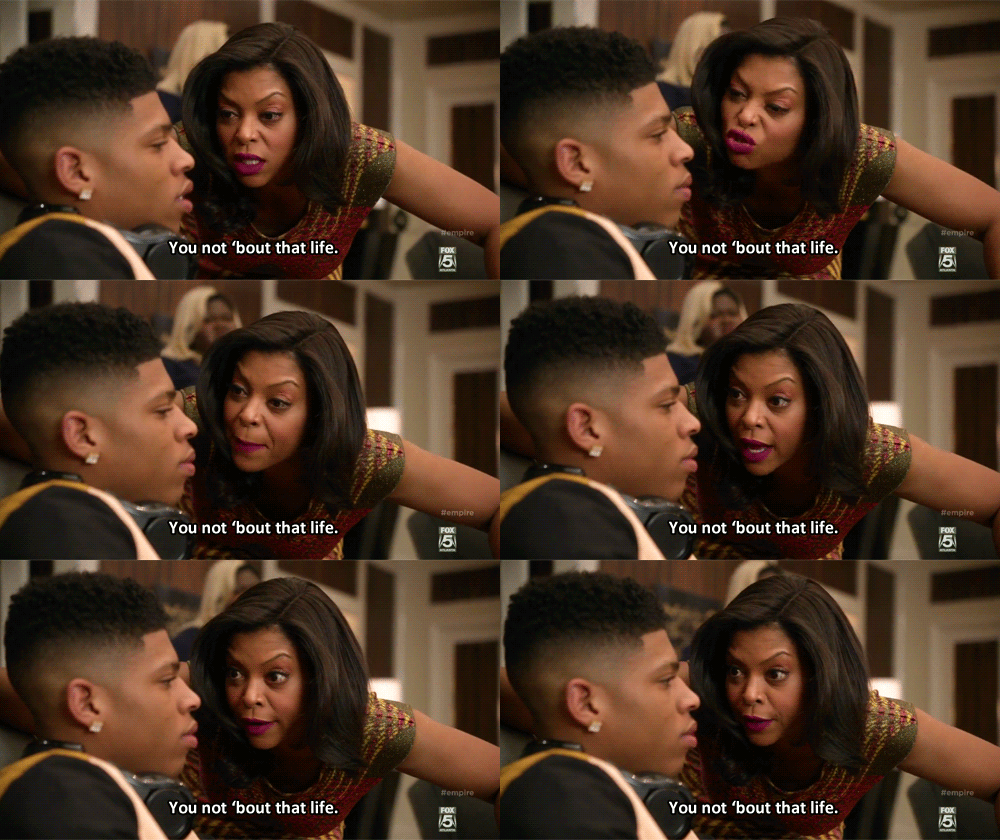
The agency shown by Cookie in Empire is amazing, even though to break a few stereotype others were enforced. I think overcoming this unequal ideology is a give and take relationship in which you have to lose some battles to win the war. Just as in real life women are starting to be made up in their image and not in the eyes of a man. For this to continue works of feminism such as Empire must to continue to be created to show the world that while equality may not be simple it is definitely achievable, we all just have to do our part.
Blondes Prefer the Rich
The 1950s was an era of change, and new ideas were being introduced. Gender roles, for example, were changing. Marilyn Monroe supports the ideal body image of the era within her movies. In the 1950s, Marilyn Monroe was best known for the “dumb blonde character,” fulfilling the sex object stereotype. As time moved on, Marilyn Monroe became more of a seductress stereotype, seen by society as a sex icon and was part of the change in the era’s attitude towards sexuality in the 1950s.
One of Marilyn Monroe’s best movies was “Gentlemen Prefer Blondes.” The movie is based upon on a character “Lorelei Lee” (Marilyn Monroe), a beautiful showgirl who is engaged to a wealthy character named “Gus Esmond” (Tommy Noonan) who believes that Marilyn is only after his money and discovers later, she really was. As Gus gets deeper into the mystery to disqualify “Lorelei Lee” from marriage, and stopping her from receiving his money.

As the movie continues Gus sends Ernie Malone, who is a private detective, to investigate what's going on. Lorelei says, “Don’t you know that a man being rich is like a girl being pretty? You wouldn’t marry a girl just because she's pretty, my goodness, doesn’t it help?” The character displays that she can be a seductress, Esmond Sr asks, “Then what do you want to marry him for?” Lorelei Lee says, “I want to marry him for YOUR money.” This is one of the many moments in the movie where the stereotypes still continue.
In the 1950s women were thought to be stupid since women didn’t go to school or didn’t finish college. “Gus” thought “Lorelei Lee” is stupid, and he was expecting her to sound stupid too. “Mr. Esmond Sr” (Gus) says, “Say, they told me you were stupid! You don’t sound stupid to me!” Lorelei Lee says, “I can be smart when it's important.” This reinforces a stereotype of women being dumb and mistreated. The only time when men wanted to listen to women, were only if they were sexy.
Our final stereotype is the character “Gus” in the movie. He is a wealthy man with lots of money and power. In the movie he is seen as an opportunity for Lorelei to get anything she wants. Also Lorelei Lee can keep all the money to herself after a divorce. This example is important because Lorelei is breaking the stereotype of a woman being dumb and only there to serve her husband. She thinks of a method to receive all the money to herself so that she can enjoy life without any worries at all. Lorelei Lee says, “I want to marry him for YOUR money.”
Our pop culture slightly changes over the years, but can still support the stereotypes that are being presented today. Women today are still being mistreated more or less. Movies, music videos, television, radio, social media or any entertainment supports the stereotypes. The movie The Wolf of Wall Street, who is a wealthy man, constantly throwing parties. As well as having sexual relationships with women throughout the movie. The movie supports the universal idea that has been continuing since the 1950s. As opposing to women they’re only there for his sexual purposes and needs. In conclusion these stereotypes keep continuing no matter what year it is, and wondering if these kind of stereotypes will continue in the future.
One of Marilyn Monroe’s best movies was “Gentlemen Prefer Blondes.” The movie is based upon on a character “Lorelei Lee” (Marilyn Monroe), a beautiful showgirl who is engaged to a wealthy character named “Gus Esmond” (Tommy Noonan) who believes that Marilyn is only after his money and discovers later, she really was. As Gus gets deeper into the mystery to disqualify “Lorelei Lee” from marriage, and stopping her from receiving his money.
As the movie continues Gus sends Ernie Malone, who is a private detective, to investigate what's going on. Lorelei says, “Don’t you know that a man being rich is like a girl being pretty? You wouldn’t marry a girl just because she's pretty, my goodness, doesn’t it help?” The character displays that she can be a seductress, Esmond Sr asks, “Then what do you want to marry him for?” Lorelei Lee says, “I want to marry him for YOUR money.” This is one of the many moments in the movie where the stereotypes still continue.
In the 1950s women were thought to be stupid since women didn’t go to school or didn’t finish college. “Gus” thought “Lorelei Lee” is stupid, and he was expecting her to sound stupid too. “Mr. Esmond Sr” (Gus) says, “Say, they told me you were stupid! You don’t sound stupid to me!” Lorelei Lee says, “I can be smart when it's important.” This reinforces a stereotype of women being dumb and mistreated. The only time when men wanted to listen to women, were only if they were sexy.
Our final stereotype is the character “Gus” in the movie. He is a wealthy man with lots of money and power. In the movie he is seen as an opportunity for Lorelei to get anything she wants. Also Lorelei Lee can keep all the money to herself after a divorce. This example is important because Lorelei is breaking the stereotype of a woman being dumb and only there to serve her husband. She thinks of a method to receive all the money to herself so that she can enjoy life without any worries at all. Lorelei Lee says, “I want to marry him for YOUR money.”
Our pop culture slightly changes over the years, but can still support the stereotypes that are being presented today. Women today are still being mistreated more or less. Movies, music videos, television, radio, social media or any entertainment supports the stereotypes. The movie The Wolf of Wall Street, who is a wealthy man, constantly throwing parties. As well as having sexual relationships with women throughout the movie. The movie supports the universal idea that has been continuing since the 1950s. As opposing to women they’re only there for his sexual purposes and needs. In conclusion these stereotypes keep continuing no matter what year it is, and wondering if these kind of stereotypes will continue in the future.
Friday, August 22, 2014
The objectification of woman
lil wayne "she will" feat. drake , This song shows how men objectify woman. Most of the time talking about getting girls, and having woman as bystanders and somewhat like servants. "now jump on that d*** and do a full split". is the first line just objectifying woman for sex.
Subscribe to:
Posts (Atom)